
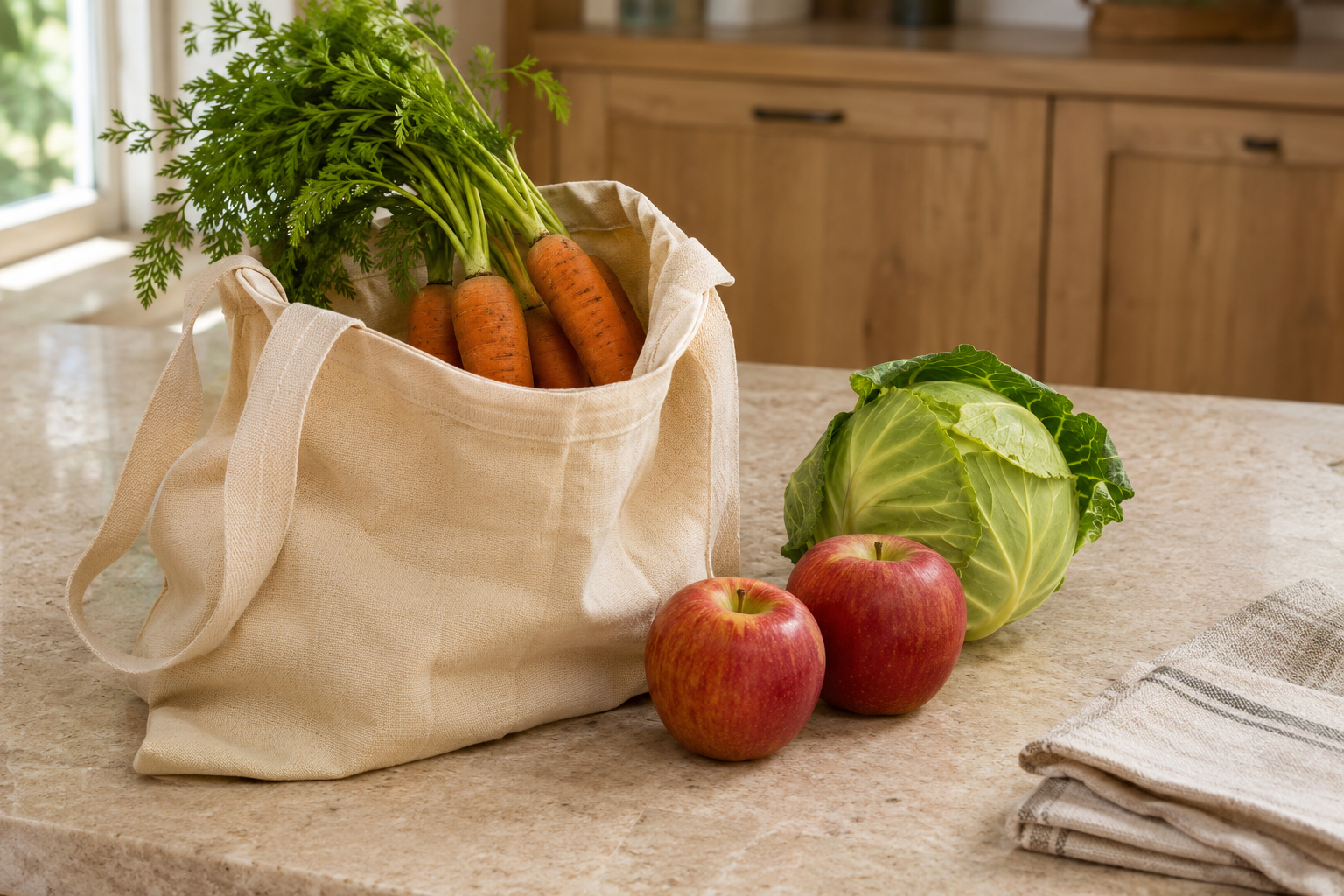
Organic, non-GMO, and bioengineered labels can raise more questions than they answer. Understanding what each label covers helps you make choices that reflect your priorities without turning grocery shopping into an all-or-nothing decision.
At Haven Provisions, thoughtful sourcing includes farming practices, clear information, affordability, and food you will actually enjoy. Here is a practical guide to reading these labels in the U.S.
Reviewed and updated November 7, 2026.
What Organic Certification Covers
USDA organic standards regulate how food is produced and handled. They include requirements for soil management, pest control, livestock feed and care, and prevention of contact with prohibited substances. Genetic engineering, sewage sludge, and ionizing radiation are prohibited.
Organic farming emphasizes practices such as crop rotation and biological or mechanical pest management. Organic livestock requirements include organic agricultural feed, outdoor access, and health-care rules. These are meaningful production standards; they do not describe every feature of an individual farm.
Organic Does Not Mean Pesticide-Free
Under the National List, natural substances are generally allowed in organic crop production unless prohibited, while synthetic substances are prohibited unless specifically allowed. Organic farmers can use approved pest-control substances when required preventive practices are insufficient.
It is more accurate to say that organic restricts which materials and methods may be used than to say it uses no pesticides or synthetic ingredients. “Natural” and “organic” also should not be treated as interchangeable claims.
Read the Wording on the Package
USDA distinguishes four labeling categories. Organic percentages exclude water and salt.
| Label wording | What it tells you |
|---|---|
| 100 percent organic | All ingredients are organic, excluding water and salt. The USDA organic seal is permitted. |
| Organic | At least 95% organic ingredients. The remainder must meet specific restrictions. The USDA organic seal is permitted. |
| Made with organic… | At least 70% organic ingredients, with additional requirements. The claim names specified ingredients or food groups; the USDA organic seal is not permitted. |
| Organic ingredients identified only in the ingredient list | Products below 70% organic content may identify individual organic ingredients. This does not make the finished product organic. |
How Organic and Non-GMO Relate
USDA prohibits intentional GMO use in organic production. Farmers and handlers must take preventive measures, such as buffer areas and cleaning shared equipment, to avoid unintended contact.
Certification is not a promise of absolute zero trace presence. USDA explains that inadvertent traces do not automatically establish a violation; the certifier investigates the circumstances and prevention practices. A “100 percent organic” ingredient claim should not be interpreted as a laboratory guarantee of zero GMO material.
The Non-GMO Project operates a separate verification program with sourcing, traceability, and testing requirements for relevant ingredients. It explicitly states that its seal is not a “GMO-free” guarantee. The seal alone does not establish compliance with USDA organic production standards.
What Does the Evidence Say About GMO Food Safety?
“GMO” is a broad term for organisms modified through genetic engineering. The food, the introduced trait, and how it is used matter when evaluating a specific product.
FDA states that foods from genetically engineered plants must meet the same safety requirements as other foods. Foods it has evaluated through its consultation process have not been found more likely to cause allergic or toxic reactions than comparable conventionally bred foods.
The National Academies’ 2016 evidence review found no substantiated evidence that the commercially available genetically engineered crops it examined posed greater human-health risks than conventional counterparts. That finding does not imply that every possible future trait needs no assessment. It does mean that broad claims linking GMO foods as a category to cancer or antibiotic resistance are not a sound basis for shopping advice.
Separate Food Safety from Farming Questions
You can prefer organic farming or GMO avoidance without needing to claim that conventionally produced food is inherently unsafe. Seed ownership, farming inputs, biodiversity, and food-system transparency are legitimate questions distinct from whether eating a particular food causes harm.
Environmental outcomes depend on the crop and management system. The National Academies review found benefits from some insect-resistant crops, including reduced use of insecticides, alongside resistance problems in weeds and target insects where management was inadequate. Genetic engineering does not describe one uniform farming practice.
What a Bioengineered Disclosure Means
The U.S. bioengineered food disclosure provides information about certain foods and ingredients. USDA states that the disclosure does not itself describe a food’s health, safety, or environmental attributes.
Its legal scope is narrower than many shoppers’ everyday use of “GMO.” Under USDA’s disclosure rules, highly refined ingredients without detectable modified genetic material do not require that disclosure. Animal foods are not considered bioengineered solely because the animal ate bioengineered feed. Absence of a disclosure is therefore not equivalent to organic or non-GMO verification.
EWG’s Dirty Dozen & Clean Fifteen
The Environmental Working Group’s Shopper’s Guide to Pesticides in Produce ranks conventional produce using pesticide-residue testing data. If you want to prioritize a few organic purchases, its Dirty Dozen can be a starting point; its Clean Fifteen highlights lower-residue options in EWG’s analysis.
These are EWG’s 2026 lists. Visit the current guide and methodology summary for updates.
| Dirty Dozen | Clean Fifteen |
|---|---|
| Spinach | Pineapple |
| Kale, collard and mustard greens | Sweet corn (fresh and frozen) |
| Strawberries | Avocados |
| Grapes | Papaya |
| Nectarines | Onions |
| Peaches | Sweet peas (frozen) |
| Cherries | Asparagus |
| Apples | Cabbage |
| Blackberries | Cauliflower |
| Pears | Watermelon |
| Potatoes | Mangoes |
| Blueberries | Bananas |
| — | Carrots |
| — | Mushrooms |
| — | Kiwi |
EWG also flags green beans and bell and hot peppers alongside its 2026 Dirty Dozen. The Clean Fifteen is not a non-GMO list; residue rankings and genetic-engineering claims address different questions.
Use the lists as a shopping preference, not a reason to skip produce you can afford. They are not government safety classifications or a measure of the risk from eating an individual food. For context, USDA’s 2024 monitoring summary reported that more than 99% of tested samples had residues below EPA benchmark levels.
Make Organic Shopping Work for Your Budget
- Choose a clear priority: If supporting organic production matters most, look for certified organic products. If GMO avoidance is your specific goal, understand the verification attached to that claim.
- Start with a few regular purchases: Choose items your household eats often, compare unit prices, and expand only when it fits your budget.
- Compare formats: Fresh, frozen, and canned options can offer different prices and levels of convenience. Check ingredients, quantity, and how much you will use.
- Read the rest of the package: Organic and non-GMO seals do not tell you everything about added sugar, sodium, allergens, or serving size.
- Ask local growers specific questions: Discuss pest management, soil practices, and certification. A local origin alone does not establish organic status.
- Keep food accessible: An organic preference should support the meals you want to make. Buying an affordable conventional option can be a sensible household decision.
For related shopping guidance, explore our beef and egg guides, or visit Farms, Ranches & Producers.
The aim is a grocery routine you can maintain: know what a label means, spend deliberately, and choose food that supports your values and everyday life.
Sources & Further Reading
- USDA: Organic Standards.
- USDA: Labeling Organic Products.
- USDA: The National List of Allowed and Prohibited Substances.
- USDA: Can GMOs Be Used in Organic Products?.
- FDA: Understanding New Plant Varieties.
- National Academies: Genetically Engineered Crops—Experiences and Prospects (2016).
- Non-GMO Project: Verification FAQ.
- USDA: Bioengineered Food Information for Consumers.
- USDA: Bioengineered Food Disclosure FAQs.
- Environmental Working Group: 2026 Shopper’s Guide, Dirty Dozen and Clean Fifteen.
- USDA: 2024 Pesticide Data Program Summary.
Leave a Reply