
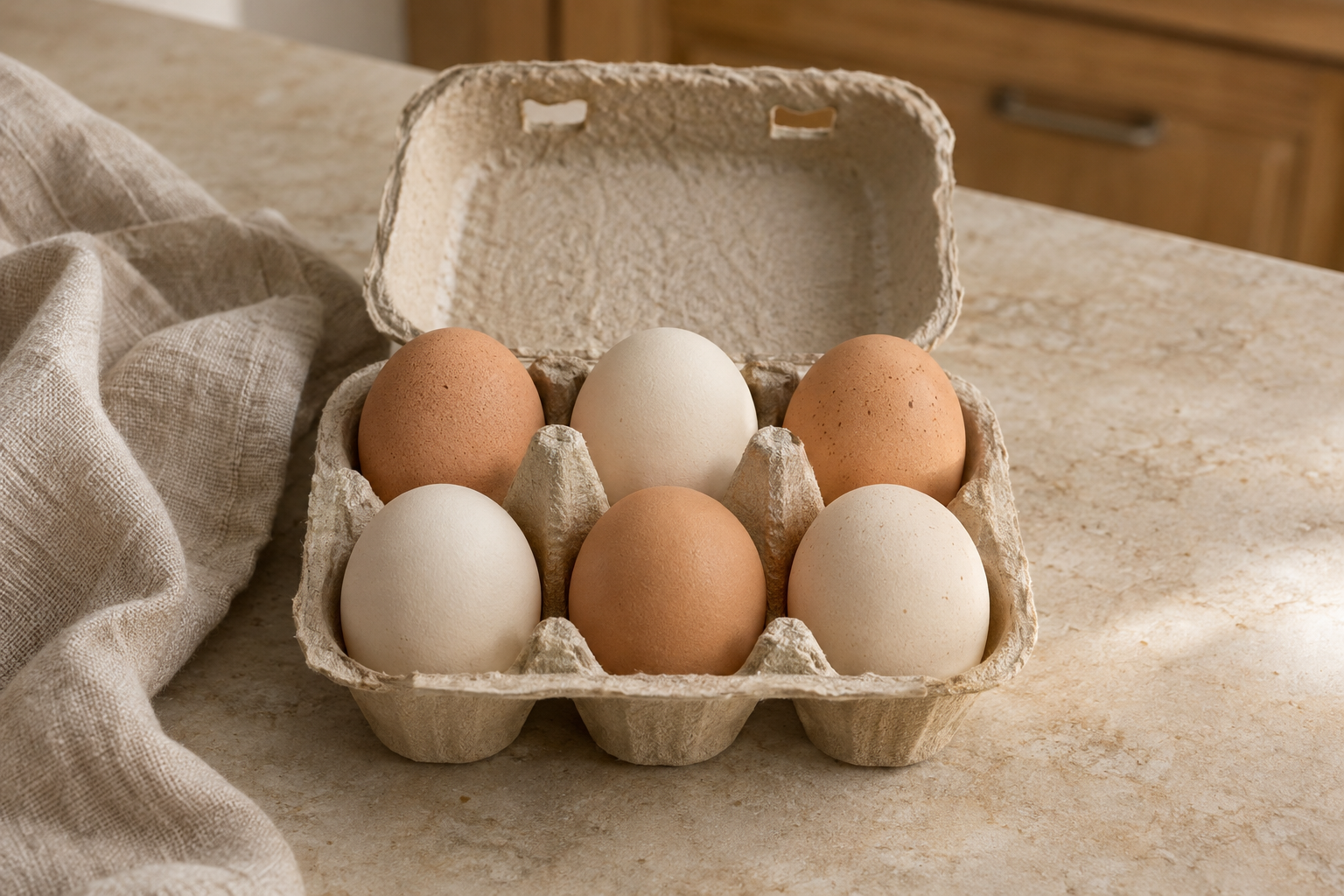
Choosing eggs can feel like sorting through a carton full of promises. Cage-free, free-range, pasture-raised, organic: each answers a different question. Understanding those differences makes it easier to choose eggs that fit your values, your kitchen, and your budget.
At Haven Provisions, thoughtful sourcing begins with clear information. Here is what to look for—and what a label alone cannot tell you.
Reviewed and updated November 7, 2026.
Start with How the Hens Are Raised
USDA explains cage-free and free-range as housing descriptions. They do not, by themselves, establish a nutritional advantage.
- Cage-free: Hens can move within indoor housing rather than living in cages. Outdoor access is not implied.
- Free-range: Hens have cage-free housing and outdoor access. The outdoor area and management practices vary, so check the producer’s explanation and any certification.
- Pasture-raised: Look for a stated standard and independent verification rather than relying on pastoral packaging. The familiar 108-square-feet-per-hen figure belongs to particular certification standards; it is not a promise you should assume from every carton carrying these words.
Read the Certification Alongside the Claim
Certified Humane’s laying-hen standards cover feed, housing, management, and animal care. The basic certification does not require outdoor access. Free-range and pasture-raised claims have additional requirements within the program; its pasture-raised standard specifies 108 square feet per hen, with provisions for pasture rotation and weather-related shelter.
Certified Animal Welfare Approved by A Greener World has its own laying-hen standards covering pasture access, housing, feed, and management. These programs are distinct. Read the actual standard attached to the seal instead of treating all welfare labels as interchangeable.
For outdoor access as a priority, look for a certification that specifically verifies the type of outdoor system you want. A farm photograph or the word “humane” alone provides less detail.
What USDA Organic Means
USDA organic standards address feed, production practices, health care, and outdoor access. Agricultural feed must be organic, with allowed supplements, and genetic engineering is prohibited. Necessary treatment cannot be withheld from a sick animal to preserve organic status.
Organic and pasture-raised describe different requirements. An organic seal does not automatically mean the farm follows a particular pasture certification. Some existing poultry operations have until 2029 to meet specified outdoor-space and related requirements under the updated organic poultry standards. If pasture conditions matter to you, ask about the farm’s current practices.
Shell Color and Yolk Color
Shell color reflects the hen’s breed; brown eggs are not inherently more nutritious than white eggs. Choose the farming practices and freshness you value rather than paying extra for a shell color.
Yolk color is influenced by pigments in the hen’s diet. A deep orange yolk can be appealing, but color alone does not verify outdoor access, welfare, or a superior nutrient profile.
Keep Nutrition Claims Specific
A housing label is not a nutrient analysis. North Carolina Cooperative Extension explains that omega-3-enriched eggs generally come from hens fed ingredients such as flaxseed, algae, or fish oil. If extra omega-3s are your goal, compare the stated amount per serving rather than assuming every organic or pastured egg contains more.
A Practical Carton Checklist
- Choose your priority: Outdoor access, organic feed, a local producer, price, or a combination. Decide which matters most before comparing cartons.
- Check the specific carton: Brands can sell several egg lines with different practices and certifications. A claim on one product does not apply automatically to the whole brand.
- Understand the grade: USDA grades AA, A, and B describe egg quality characteristics. A grade shield is separate from organic or animal-welfare certification.
- Read the pack date: On USDA-graded cartons, the three-digit number identifies the day of the year the eggs were packed: 001 is January 1. It is separate from a sell-by date.
- Buy an amount you will use: Compare equivalent sizes and quantities. A larger carton is good value only if it suits your household.
- Ask a local farmer: How do hens access pasture? What are they fed? When were the eggs packed, and how are they kept cold? Local sourcing creates an opportunity for questions; it does not automatically establish particular farming practices.
For food producers to explore, visit Haven Provisions’ Farms, Ranches & Producers. Keep checking the individual product’s current information when you shop.
Bring Them Home and Store Them Well
For U.S. shoppers, FDA recommends buying refrigerated eggs with clean, uncracked shells. Refrigerate promptly at 40°F (4°C) or below, keep them in their original carton, and use within three weeks for best quality.
Cook eggs until the whites and yolks are firm; egg dishes should reach 160°F (71°C). For preparations served raw or undercooked, use pasteurized shell eggs or pasteurized egg products. “Pasture-raised” describes farming, while “pasteurized” describes treatment of the egg—they are different terms.
A thoughtful choice does not have to be the most expensive carton. Buy eggs you can use, verify the practices that matter to you, and leave the rest of the packaging promises on the shelf.
Sources & Further Reading
- USDA: Shell Egg Grading Questions and Answers.
- Certified Humane: Laying-Hen Standards.
- A Greener World: Laying-Hen Standards.
- USDA: Organic Standards.
- USDA: Organic Livestock and Poultry Standards.
- USDA: Brown and White Egg Nutrition.
- USDA: Egg Appearance and Yolk Color.
- North Carolina Cooperative Extension: Understanding Egg Labels.
- USDA: Egg Grading Shields.
- FDA: Egg Safety.
Leave a Reply