
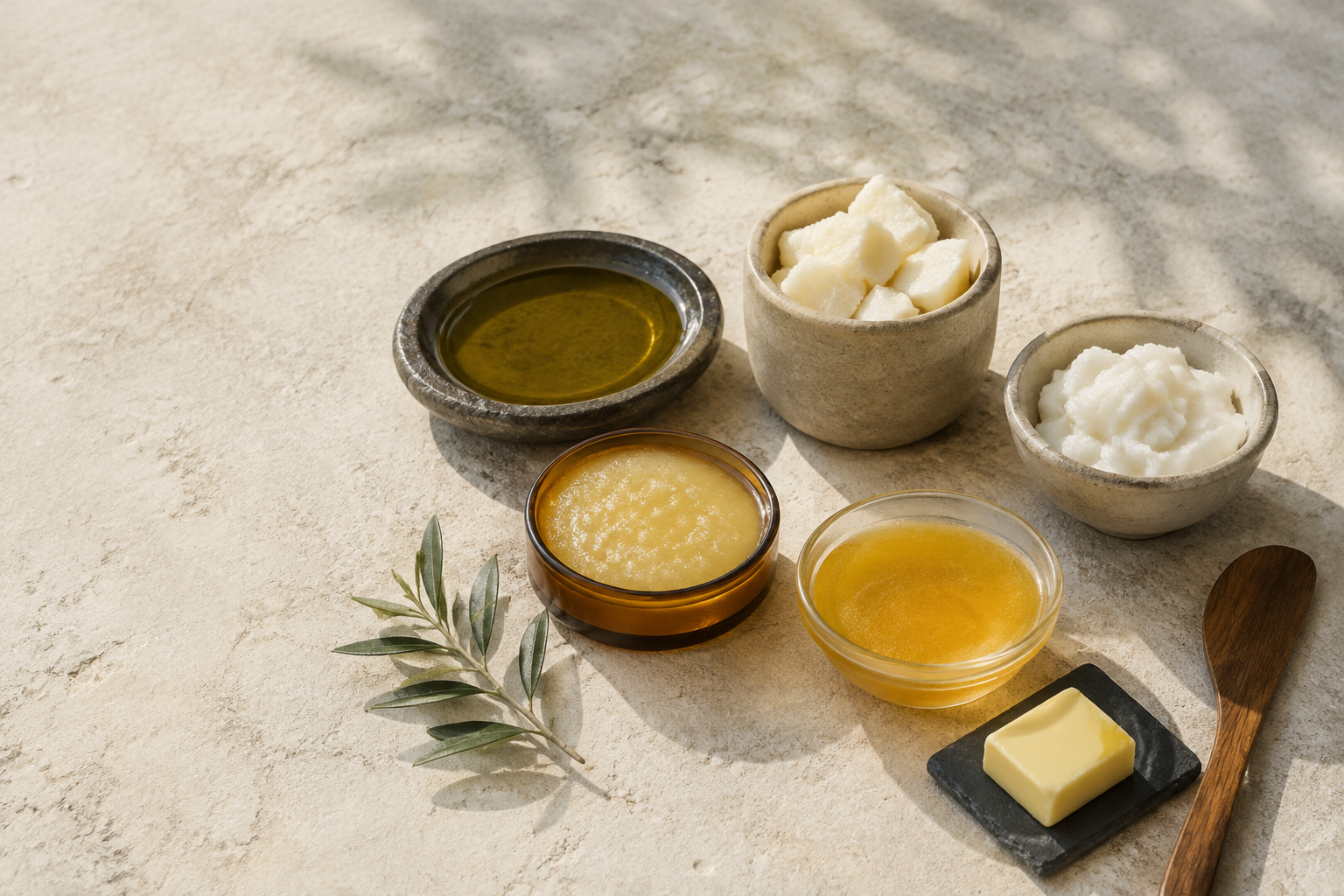
At Haven Provisions, cooking fats are chosen for flavor, culinary tradition, practical use, sourcing, and the needs of the person eating the meal.
We do not believe traditional animal fats should be demonized or reduced to a single nutrient. Butter, ghee, tallow, lard, and duck fat have supported culinary traditions for generations. They contribute flavor, texture, satisfaction, and heat performance that can make home cooking more enjoyable and easier to maintain.
In our work with clients, we encourage people to consider a range of traditional cooking fats alongside carefully selected plant oils. We do not use or recommend canola oil in our own approach. This is based on our preferences concerning refinement, sourcing, flavor, and the kinds of food systems we want to support—not on a claim that a normal serving of canola oil has been proven toxic.
Extra-virgin olive oil remains one of our preferred plant oils. Depending on the household, recipe, health history, and cultural traditions, we may also incorporate butter, ghee, tallow, lard, duck fat, coconut oil, avocado oil, or sesame oil.
The goal is not to replace fear of saturated fat with fear of unsaturated fat. It is to help people cook nourishing meals with fats they understand, enjoy, and use intentionally.
Reviewed and updated November 7, 2026.
What Animal Fats Actually Provide
Rendered animal fats are composed primarily of fatty acids stored as triglycerides. They do not provide protein, fiber, or meaningful quantities of minerals.
Their fatty-acid and vitamin content varies according to:
- The animal species and breed
- What the animal ate
- The tissue from which the fat was rendered
- Seasonal and agricultural conditions
- Rendering temperature
- Filtration
- Storage time and exposure to light, heat, and oxygen
Animal fats are therefore not nutritionally interchangeable, and their composition cannot be determined from appearance alone.
Butter
Butter contains a mixture of saturated, monounsaturated, and smaller amounts of polyunsaturated fatty acids. It also provides:
- Vitamin A
- Small and variable amounts of vitamins E and K
- Naturally occurring cholesterol
- Short- and medium-chain fatty acids
- Butyrate and other short-chain fatty acids in modest amounts
Vitamin and fatty-acid concentrations vary with the animal’s diet and the season.
Butter contributes flavor and performs well in baking and lower-to-moderate-temperature cooking. Its milk solids can brown or burn during higher-temperature cooking.
Butter does contain saturated fat, and it can raise LDL cholesterol in some people. This does not make it a poison, but neither should it be promoted as an unlimited therapeutic food.
Ghee
Ghee is produced by heating butter and removing most of its water and milk solids.
Its potential advantages include:
- A higher smoke point than ordinary butter
- Long culinary history in South Asian food traditions
- Concentrated buttery flavor
- Very low lactose content, but not a milk-allergy-safe substitute. People with a milk allergy should avoid ghee unless their allergy clinician specifically advises otherwise
- Fat-soluble compounds retained from butter in variable amounts
Because ghee is concentrated butterfat, it is also rich in saturated fat and energy. Its higher smoke point describes its cooking performance; it does not automatically make it metabolically superior to every other fat.
Beef Tallow
Tallow is rendered primarily from beef fat. Its predominant fatty acids generally include:
- Oleic acid, a monounsaturated fat
- Palmitic acid, a saturated fat
- Stearic acid, a saturated fat that tends to have a more neutral effect on LDL cholesterol than palmitic acid
- Smaller amounts of other fatty acids
Tallow’s relatively low polyunsaturated-fat content makes it resistant to oxidation during cooking compared with many highly polyunsaturated oils. It can work well for roasting, sautéing, and occasional frying.
Claims that tallow is an abundant source of vitamins A, D, E, and K should be made cautiously. Concentrations vary substantially, and ordinary rendered tallow should not be treated as a dependable source of those nutrients without product-specific testing.
Lard
Lard is rendered pork fat. Depending on the animal’s diet and the tissue used, lard commonly provides:
- Monounsaturated oleic acid
- Saturated palmitic and stearic acids
- Polyunsaturated linoleic acid
Lard can produce desirable texture in pie crusts, biscuits, tortillas, and other traditional foods. It also performs well for roasting and sautéing.
Lard is sometimes promoted as a rich source of vitamin D. Pork fat can contain vitamin D, especially when pigs receive substantial sunlight or vitamin-D-enriched feed, but concentrations vary widely. Commercial lard should not automatically be considered a reliable vitamin-D supplement.
Duck Fat
Duck fat has a distinctive culinary profile and is one of our favorite traditional cooking fats.
Its fatty acids commonly include:
- Oleic acid
- Linoleic acid
- Palmitic acid
- Stearic acid
- Palmitoleic acid
Studies of duck fatty tissue and duck meat generally find a substantial proportion of unsaturated fat, particularly monounsaturated oleic acid. The exact profile depends on breed, feed, tissue, and rearing conditions.
Duck fat works particularly well for:
- Roasted potatoes and root vegetables
- Sautéed greens
- Mushrooms
- Beans
- Poultry
- Savory grains
- Traditional confit preparations
It provides energy and helps the body absorb fat-soluble vitamins from the rest of a meal, as do other dietary fats.
Does Duck Fat Have Special Benefits for Women?
Adequate dietary fat is important for everyone, including women. Fat contributes to:
- Absorption of vitamins A, D, E, and K
- Cell-membrane structure
- Production of steroid hormones
- Energy intake
- Satiety
- Normal skin-barrier function
- Provision of essential fatty acids
Women who chronically consume too little energy or too little dietary fat may experience menstrual disturbances or other endocrine effects. However, these facts do not establish that duck fat specifically corrects hormonal imbalances, improves fertility, relieves menopause symptoms, or produces a unique women’s-health benefit.
We did not find controlled human trials demonstrating that duck fat itself provides benefits exclusive to women.
The evidence-conscious way to describe it is:
Duck fat is a flavorful traditional fat with a substantial monounsaturated component. It can help women—and other adults—consume satisfying meals and absorb fat-soluble nutrients, but it has not been shown to function as a female hormonal treatment.
That distinction allows us to appreciate duck fat without assigning it medicinal properties that have not been demonstrated.
Poultry Fat and Schmaltz
Rendered chicken or goose fat—often called schmaltz—contains a mixture of monounsaturated, saturated, and polyunsaturated fatty acids.
It contributes deep flavor to soups, roasted vegetables, matzo balls, rice dishes, and other traditional foods. Its composition varies with the bird’s diet, and it is generally more unsaturated than beef tallow.
Bacon Fat
Bacon fat can be used sparingly to flavor greens, beans, eggs, or vegetables. It contains both monounsaturated and saturated fat.
Because bacon is cured and usually high in sodium, we view its rendered fat primarily as a flavoring rather than a principal everyday cooking fat. Burnt particles should be strained out before storage.
Animal Fats for Skin and Hair
Animal fats also have a long history in soaps, balms, salves, hair dressings, and protective skin preparations.
Topically applied fats can act as:
- Emollients, helping soften rough skin
- Occlusives, reducing water loss by forming a surface barrier
- Carriers, helping disperse other oil-soluble cosmetic ingredients
Tallow contains fatty acids also found in human skin-surface lipids, which provides a plausible reason it can feel compatible with dry skin. However, a 2024 scoping review found substantial gaps in human research on topical tallow. Evidence is not strong enough to claim that tallow treats eczema, acne, psoriasis, rosacea, infections, or skin aging.
Research is even more limited for topical lard and duck fat.
Practical Safety Considerations
If using an animal-fat balm:
- Choose properly rendered, filtered, fresh fat from a trustworthy source.
- Store it away from heat and light.
- Discard it if the odor becomes stale, paint-like, sour, or otherwise rancid.
- Use clean utensils rather than repeatedly dipping fingers into a jar.
- Patch-test a small area before widespread use.
- Stop if burning, redness, itching, swelling, or breakouts develop.
- Avoid using homemade preparations on broken or infected skin.
- Use particular caution if you have acne-prone or folliculitis-prone skin.
- Consult a dermatologist before applying it to an active skin disorder.
Pure rendered fat does not contain the preservatives used in professionally formulated water-containing cosmetics. An anhydrous balm has less microbial-growth potential than a product containing water, but contamination and oxidation are still possible.
For hair, a very small amount may help coat dry ends and reduce friction. Too much can weigh hair down, irritate the scalp, or be difficult to remove. These are cosmetic effects, not evidence that animal fat stimulates hair growth or treats hair loss.
Animal fats also should not be used as substitutes for tested broad-spectrum sunscreen.
Why We Choose Not to Use Canola Oil
Canola oil is low in saturated fat and contains monounsaturated fat, linoleic acid, and some alpha-linolenic acid. Human research has not established that properly produced canola oil is inherently toxic.
Nevertheless, it is not a fat we use or recommend within our Haven Provisions approach.
Our reasons include:
- Preference for fats with a longer place in family or culinary traditions
- Preference for distinctive flavor rather than neutral industrial oils
- Concern about reliance on highly refined ingredients
- Desire for greater transparency about sourcing and processing
- Preference for extra-virgin olive oil and traditional animal fats
- A broader goal of reducing ultra-processed food consumption
This reflects our culinary and sourcing philosophy, not proof that every person who consumes canola oil will be harmed.
Readers deserve to know both what the broader evidence says and where Haven Provisions makes a different values-based choice.
Culinary Tradition and Cardiovascular Health
The American Heart Association recommends replacing sources of saturated fat with sources of unsaturated fat to lower LDL cholesterol and cardiovascular risk.
Culinary tradition and food-system preferences can be considered alongside this cardiovascular evidence. Individual choices should account for the overall dietary pattern, cultural context, and clinical risk; a sourcing preference does not overturn evidence about LDL cholesterol.
Our approach considers:
- The complete food or meal
- Degree of processing
- Cooking method
- Individual response
- Metabolic health
- Family history
- Cultural traditions
- Food access
- Satiety
- Ingredient quality
- Environmental and animal-welfare considerations
At the same time, disagreeing with an organization does not erase the evidence it cites. Saturated fats can raise LDL cholesterol, and elevated LDL is a causal factor in atherosclerotic cardiovascular disease.
People with elevated LDL, familial hypercholesterolemia, established cardiovascular disease, diabetes, or multiple cardiovascular risk factors should make major dietary-fat changes with an appropriately qualified clinician.
Haven Provisions can support the use of animal fats without promising that they are universally protective or appropriate in unlimited quantities.
Seed Oils, Sunlight, and Skin Cancer: What Is Known?
The possibility that dietary fatty acids influence the skin’s response to ultraviolet radiation is scientifically interesting.
Animal experiments have found that changing dietary omega-6 and omega-3 fatty acids can influence UV-induced inflammation and tumor development. Small human studies have also investigated whether omega-3 supplementation affects sunburn response, immune suppression, or UV-related DNA damage.
These findings provide possible mechanisms to study. They do not establish that seed oils cause skin cancer in humans.
One large U.S. observational analysis found modest associations between higher polyunsaturated or omega-6 fat intake and some skin cancers. For example, the highest polyunsaturated-fat intake group had a 16% higher relative rate of squamous-cell carcinoma than the lowest group. The researchers emphasized that further studies were required.
Important limitations include:
- Observational studies cannot establish cause and effect.
- Diet is measured imperfectly.
- Seed-oil intake can accompany other dietary and lifestyle patterns.
- Sun exposure is difficult to measure accurately over decades.
- Relative-risk increases can sound more dramatic than their absolute effect.
- Different forms of skin cancer have different biological and environmental risk factors.
Other human evidence is not consistent with a causal claim. A case-control study using blood fatty-acid measurements found no major association between linoleic acid and melanoma. In the large Women’s Health Initiative randomized dietary trial, a lower-fat dietary pattern did not change the overall incidence of melanoma or nonmelanoma skin cancer.
The article “Seed Oil, Sunscreen, and Sunlight: The Facts You Need to Know” presents a practitioner’s interpretation of mechanistic, animal, historical, and observational evidence. It can be included as a perspective, but it is not itself proof that seed oils caused the increase in skin-cancer diagnoses.
What We Can Say Responsibly
At present:
- Dietary fat may influence skin biology and UV-related inflammatory pathways.
- Omega-3 intake is being studied for possible photoprotective effects.
- Some observational research has reported associations between polyunsaturated-fat intake and skin-cancer risk.
- Results across human studies are inconsistent.
- No clinical trial has demonstrated that avoiding seed oils prevents skin cancer.
- No animal fat has been proven to function as an internal sunscreen.
Ultraviolet radiation remains the best-established preventable cause of skin cancer. Skin type, cumulative UV exposure, blistering sunburns, tanning beds, age, genetics, certain moles, and immune suppression also influence risk.
Dietary choices should not replace:
- Protective clothing
- Shade
- Avoiding intentional tanning
- Broad-spectrum SPF 30 or higher sunscreen on skin not covered by protective clothing during outdoor exposure
- Regular examination of changing or suspicious lesions
- Professional skin checks based on individual risk
Questions about dietary fats and skin biology remain open research topics. They should not become instructions to replace sun protection with a change in cooking fat.
A Practical Approach
If you prefer traditional fats and wish to reduce refined seed oils, a balanced transition might look like this:
- Use extra-virgin olive oil for dressings and much everyday cooking.
- Use butter or ghee when their flavor improves the recipe.
- Roast vegetables with tallow, duck fat, lard, or poultry fat when appropriate.
- Use sesame oil primarily for its distinctive flavor.
- Eat whole-food fat sources such as eggs, fish, olives, avocado, nuts, and seeds.
- Include omega-3-rich seafood when possible.
- Limit foods fried in repeatedly heated oil.
- Reduce ultra-processed foods without becoming fearful of occasional exposure.
- Choose animal fats from sources aligned with your animal-welfare and environmental values.
- Render and store fats carefully to minimize waste and rancidity.
- Consider personal cholesterol response and medical history.
The purpose is not dietary perfection. It is to restore discernment, culinary knowledge, and individual choice.
Cooking With Intention
Haven Provisions does not demonize saturated fat, and it does not treat traditional animal fats as dietary mistakes.
Butter, ghee, tallow, lard, poultry fat, and duck fat can all have a meaningful place in a nourishing kitchen. They bring flavor, satisfaction, cultural continuity, and useful cooking properties. Some can also serve as simple topical emollients when prepared and used carefully, although clinical evidence for treating skin or hair conditions remains limited.
We choose not to use canola oil and prefer extra-virgin olive oil and traditional animal fats. That preference reflects our values, culinary experience, food traditions, and interpretation of the available research.
It does not require claiming that canola oil is proven poison, that duck fat balances female hormones, or that seed oils have been established as a cause of skin cancer.
Haven Provisions’s role is to examine difficult questions without hiding uncertainty. We can challenge conventional nutrition messaging, preserve traditional food wisdom, and ask for better research while still distinguishing a hypothesis from a demonstrated fact.
That is how we build guidance that is both independent and trustworthy.
Sources & Further Reading
- Pereira, A. S., & Stadelman, W. J. (1976). Total Fatty Acid Composition of Duck Fatty Tissues. Poultry Science, 55(4), 1464–1466.
- Quaresma, M. A. G., et al. (2024). Nutritional Value of the Meat Lipid Fraction Obtained From Mallard Duck. Poultry Science, 103(2), 103290.
- Russell, M. F., et al. (2024). Tallow, Rendered Animal Fat, and Its Biocompatibility With Skin: A Scoping Review. Cureus, 16(5), e60981.
- Park, M. K., Li, W. Q., & Qureshi, A. A. (2018). Fat Intake and Risk of Skin Cancer in U.S. Adults. Cancer Epidemiology, Biomarkers & Prevention, 27(7), 776–782.
- Vinceti, M., et al. (2013). Serum Fatty Acids and Risk of Cutaneous Melanoma: A Population-Based Case-Control Study. Dermatology Research and Practice, 2013, 659394.
- Gamba, C. S., et al. (2013). Low-Fat Diet and Skin Cancer Risk: The Women’s Health Initiative Randomized Controlled Dietary Modification Trial. Cancer Epidemiology, Biomarkers & Prevention, 22(9), 1509–1519.
- Black, H. S., & Rhodes, L. E. (2016). Potential Benefits of Omega-3 Fatty Acids in Non-Melanoma Skin Cancer. Journal of Clinical Medicine, 5(2), 23.
- National Cancer Institute. Skin Cancer Prevention—Health Professional Version.
- van der Pols, J. C., et al. (2011). Reduced Melanoma After Regular Sunscreen Use: Randomized Trial Follow-Up. Journal of Clinical Oncology, 29(3), 257–263.
- Cambridge University Hospitals: Milk Allergy.
This article provides general education and reflects Haven Provisions’ culinary philosophy and interpretation of the available research. It does not diagnose disease, replace individualized medical care, or establish that any particular fat prevents or causes cancer.
Leave a Reply