
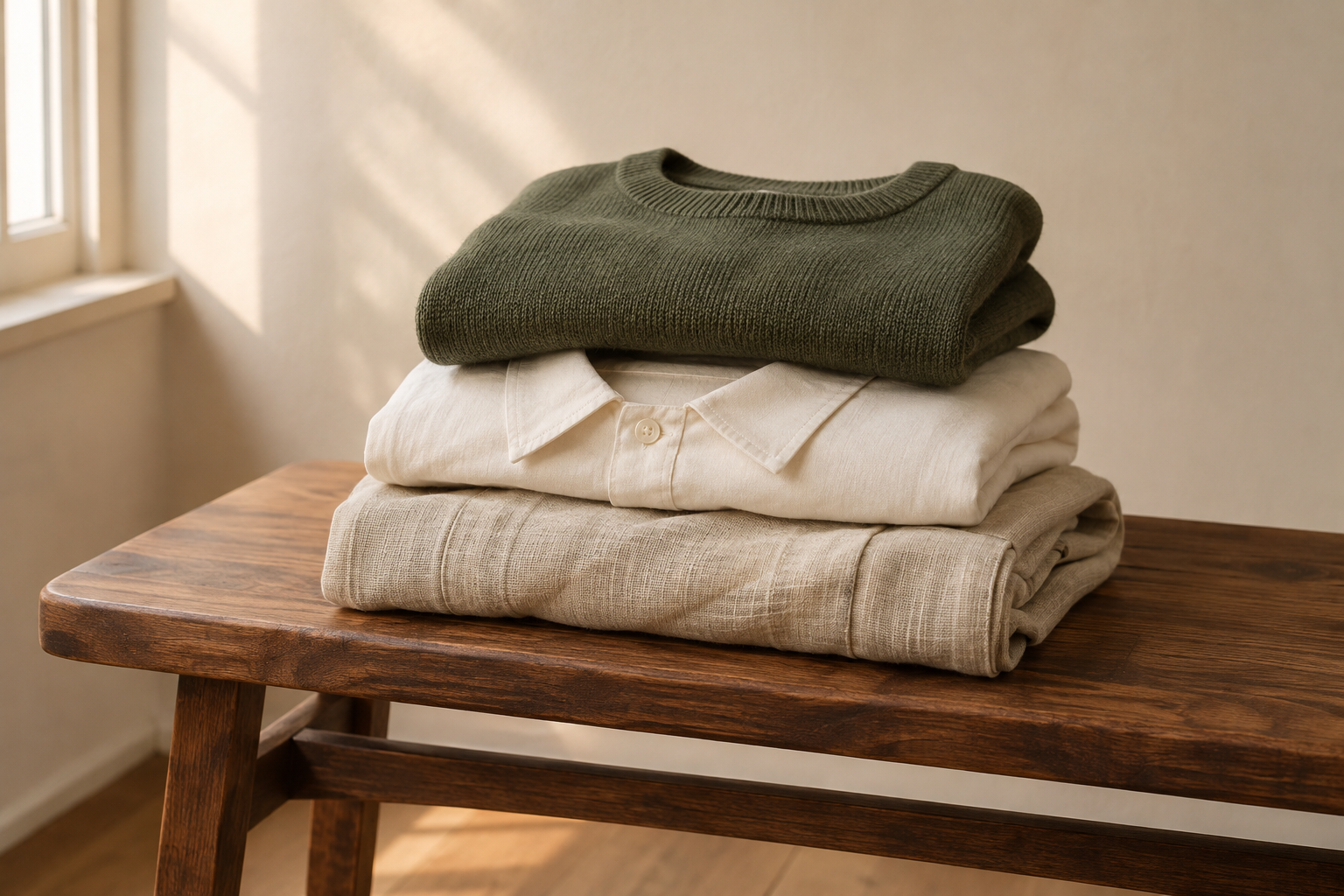
Years ago, while trying to understand recurring skin irritation, I noticed that some synthetic garments felt uncomfortable against my skin. That experience led me toward a wardrobe of natural materials—a preference I still carry into River Ternary.
It is a personal experience, rather than proof that every synthetic fabric is harmful or every natural fabric is gentle. For me, thoughtful clothing choices bring Body, Mind, and Home together: comfort, a wardrobe that feels like my own, and a manageable routine for caring for what I keep.
Reviewed and updated November 7, 2026.
Start With the Material—and the Garment
Natural textile fibers include plant fibers such as cotton and flax, and animal fibers such as wool and silk. Hemp is another plant-based option.
The fiber is only part of the experience. Fabric construction, thickness, fit, seams, dyes, and finishes also shape how a garment feels and wears. A loosely woven linen shirt and a dense cotton jacket have different jobs, even though both use natural fibers.
A Practical Guide to Common Natural Fibers
| Material | What to consider |
|---|---|
| Cotton | A plant fiber used in woven shirts, jersey basics, denim, and many other fabrics. Compare the actual weight, weave, and feel; “cotton” covers a wide range of garments. |
| Linen | Made from flax. Its textured appearance and tendency to crease can suit a relaxed wardrobe. Decide whether you enjoy that finish or will find its upkeep frustrating. |
| Hemp | Another plant fiber used in clothing, often in blends. Read the full composition rather than assuming a hemp description means the garment contains no other fibers. |
| Wool and cashmere | Animal fibers used in knitwear, tailoring, and layers. Try the fabric against your skin and check the care instructions; softness varies between products. |
| Silk | An animal fiber used in woven and knitted fabrics. Compare opacity, drape, and care requirements. Silk identifies the fiber; satin identifies a weave and may be made from other fibers. |
Comfort Is Personal
Natural fabrics can be enjoyable to wear, but they are not automatically hypoallergenic. A wool sweater that feels soft to one person may feel prickly to another. A smooth shirt can still have a troublesome seam, dye, or finish.
The American Academy of Dermatology identifies clothing dyes, metals, fabrics, and some finishing chemicals as possible triggers for contact dermatitis. If a garment repeatedly produces an itchy rash, stop wearing it and seek advice if symptoms persist. Fiber preference should support comfort, not substitute for identifying the actual cause.
For exercise, consider sweat and friction as well as fiber content. Our workout clothing guide explores those practical trade-offs.
Where Lyocell, Modal, and Bamboo Fit
Lyocell, modal, and viscose are regenerated cellulosic fibers, commonly produced from dissolved wood pulp. They have a plant-derived starting material but are manufactured fibers, distinct from cotton or linen. Their impacts depend on sourcing and processing.
TENCEL is Lenzing’s brand for lyocell and modal fibers, rather than a separate botanical fiber. Likewise, a branded fiber name is not a complete garment composition. Check what it is blended with and which claims apply to that specific product.
Many soft textiles marketed as “bamboo” are rayon made from bamboo. The FTC explains why that distinction matters. A bamboo origin does not, by itself, establish that the finished fabric is naturally antibacterial or environmentally preferable.
Natural Does Not Automatically Mean Low Impact
The European Environment Agency describes impacts throughout a textile’s life: growing or producing the fiber, manufacturing, transport, washing, and disposal. Natural fibers involve land, water, and farming inputs; synthetic fibers involve energy and chemical feedstocks. Dyeing and finishing matter across material categories.
Instead of declaring one fiber universally best, ask which garment will work well for you, how it was made, how often you will wear it, and whether it can be cared for and repaired.
Be careful with blanket biodegradability promises, too. The FTC’s Green Guides explain why decomposition claims need appropriate conditions and evidence. A fiber’s ability to break down under some conditions does not make an entire finished garment suitable for home composting or mean it quickly disappears in landfill.
Ask Specific Questions About Animal Materials
For wool, cashmere, silk, leather, or down, consider animal welfare alongside durability and personal values. Ask for traceable sourcing and a named standard rather than relying on an “ethical” or “cruelty-free” description alone. A “peace silk” claim deserves an explanation of the actual practices it covers.
Textile Exchange’s Responsible Wool Standard addresses sheep welfare and land management. Its Responsible Down Standard includes prohibitions on live plucking and force-feeding. Check the specific product’s certification and the scope of the standard.
For leather alternatives described as vegan or plant-based, ask about the complete material, backing, coatings, durability, and repair options. Those words alone do not establish biodegradability or a lower overall environmental impact.
Understand What a Certification Covers
- GOTS: The Global Organic Textile Standard covers organic fiber content and environmental, chemical, and social criteria through processing. Different label grades apply; a GOTS label does not necessarily mean a garment is 100% cotton.
- OEKO-TEX STANDARD 100: Tests textiles for harmful substances against the program’s criteria. It does not, by itself, establish that the fibers are natural or organically grown.
- Check the exact item: A brand may sell certified and uncertified products. Verify the product and claim you are buying rather than extending one certification to everything in its collection.
Build a Wardrobe You Can Keep Using
- Read the sewn-in label: The FTC explains that most textile and wool products must list fiber content. Compare that information with the product headline.
- Try before committing: Notice texture at the neckline, waistband, and underarms. Move around and check whether the fit supports your daily activities.
- Check the care commitment: Read washing and drying instructions before purchasing. Choose garments whose upkeep fits your time, space, and budget.
- Inspect the construction: Look at seams, buttons, fabric condition, and whether a small repair or alteration could extend its use.
- Start with what you own: Keep comfortable, useful pieces in rotation. Add or replace deliberately rather than rebuilding a wardrobe all at once.
For product ideas, explore River Cabinet Picks. For care, see our air-drying guide and laundry product guide.
My preference remains natural materials, chosen with care. The useful goal is a wardrobe that feels good to wear, reflects your values, and is practical enough to keep caring for.
Sources & Further Reading
- Canadian Conservation Institute: Natural Fibres.
- Textile Exchange: Plant Fibers.
- Textile Exchange: Manmade Cellulosic Fibers.
- Lenzing: TENCEL Lyocell and Modal Fibers.
- American Academy of Dermatology: Contact Dermatitis.
- European Environment Agency: Textiles, Environmental Impacts, and Design.
- FTC: Environmental Claims and the Green Guides.
- FTC: Apparel and Labeling.
- FTC: Bamboo and Rayon Textile Claims.
- GOTS: Key Features.
- OEKO-TEX: STANDARD 100.
- Textile Exchange: Wool and Responsible Sourcing.
- Textile Exchange: Responsible Down Standard.
Leave a Reply