
A useful laundry product should clean your clothes, suit your fabrics, and be straightforward to use. Thoughtful packaging matters, too, but the best choice is one that works in your home without adding unnecessary steps.
If you are trying to simplify your laundry shelf, begin with an everyday detergent that meets your needs. Add a specialty wash or stain treatment only when your clothes call for it. You do not need a separate product for every load.
Reviewed and updated November 7, 2026.
Start With Your Machine and Your Clothes
- Check machine compatibility. If your washer requires high-efficiency detergent, look for the HE designation. Maytag explains that HE detergents are designed for lower-water machines, with low-sudsing formulas.
- Read the garment labels. Everyday cotton clothing, delicate knits, and household linens may need different products and settings.
- Keep a suitable wash for wool. Woolmark recommends a mild, neutral detergent and advises against enzyme detergents and either chlorine or oxygen bleach on wool. Check silk and other delicate fabrics separately.
- Consider your usual loads. Work clothes, lightly worn shirts, muddy outdoor clothing, and kitchen linens do not all present the same cleaning task.
Look Beyond “Clean” and “Natural”
Words such as “clean,” “plant-based,” and “non-toxic” do not tell you everything about a finished product. An ingredient’s source alone does not establish how the formula will perform or whether it suits your needs.
Look for a complete ingredient disclosure, clear directions, and specific claims you can check. Rather than treating a long ingredient blacklist as a buying rule, consider the formulation, intended use, and any ingredients you already know you need to avoid.
The EPA Safer Choice label is one useful reference. The program evaluates ingredients along with performance and other product criteria. Check the exact item in EPA’s product directory; one certified product does not establish that every item from a brand is certified.
Choose Fragrance Deliberately
If you have eczema, the American Academy of Dermatology recommends fragrance-free, dye-free laundry detergent. AAD also distinguishes fragrance-free products from “unscented” ones, which may contain masking fragrance.
For products in the Safer Choice program, EPA offers an additional fragrance-free designation. Essential oils are still a source of scent; they do not make a fragranced product fragrance-free. If your aim is to avoid fragrance, keep that preference consistent across detergent and optional laundry additives.
A “sensitive skin” claim is a starting point for reading the label, not a promise that everyone will tolerate the product. If a detergent does not agree with you, choose another suitable option rather than continuing because of its marketing.
Compare Formats by How You Will Use Them
- Liquid: Check the measuring instructions and whether the product permits direct pretreatment of stains. Concentration varies, so do not carry an old dose over to a new formula.
- Powder: Check how and where to add it, along with its recommended water temperature and storage conditions.
- Tablets, sheets, and packets: Compare the dose for your typical load, machine compatibility, and instructions for placement. A compact format alone does not establish cleaning performance or environmental impact.
- Concentrates and refills: Check any dilution steps, the container requirements, and how readily you can obtain refills. Choose a system you can keep using.
Compare cost per recommended wash rather than price per package. Include any extra dose required for your usual load and any shipping or refill costs. The least expensive package is not always the lowest-cost routine.
Ask Specific Questions About Packaging
A refill, a cardboard box, or a reusable container can fit a preference for less waste. Look at the whole purchase: packaging components, how often they need replacing, and the disposal options available where you live.
The FTC’s guide to environmental claims explains why terms such as “biodegradable” and “compostable” need context. Check whether a claim refers to the detergent, a film, or the outer packaging, and what conditions are required. Do not assume that something that dissolves in wash water belongs in a home compost bin.
Use up a product that works for you before replacing it for its appearance alone. A reliable routine with fewer repeat purchases and rewashes is a practical place to begin.
Buy Fewer Extras and Use Them Well
Start with detergent, then address a specific problem if one remains. A stain treatment, whitener, fabric conditioner, or sanitizer serves a different purpose; none should be an automatic requirement for every load.
For targeted help, use the Practical Stain Removal Guide or How to Brighten White Laundry Without Chlorine Bleach. These explain fabric limits and why improvised mixtures are not a good default.
Follow the washer manual for maintenance and additives. For example, Whirlpool warns that vinegar can damage washer components over time; do not assume it is a suitable routine rinse additive for your machine.
Let Your Habits Support the Product
Measure the recommended dose, sort by care needs, and leave room for items to move. EPA WaterSense recommends an appropriate detergent amount to avoid unnecessary extra rinsing and using cold water as much as possible. Match the cycle to the garment and cleaning task.
When the care label and your drying space allow, consider air drying. A small adjustment to loading, dosing, or drying may make more difference than another item on the shelf.
A Laundry Shelf That Works for You
Before your next purchase, ask: Will this work with my machine and clothes? Is the dose clear? Does it suit my fragrance preference? Can I afford to keep using it? What will I do with the packaging?
For individual product selections, visit River Cabinet. Explore more practical household routines in Healthy Home & Environment. The aim is cared-for clothes and linens, with less guesswork in your day.
Sources & Further Reading
- EPA: Learn About the Safer Choice Label; Product Directory; Standard and Fragrance-Free Criteria.
- American Academy of Dermatology: Atopic Dermatitis Skin Care.
- Maytag: Understanding HE Detergent; Woolmark: Choosing a Wool Detergent.
- FTC: Environmental Marketing Claims; EPA WaterSense: Home Maintenance.
- Whirlpool: Vinegar and Washing Machines.
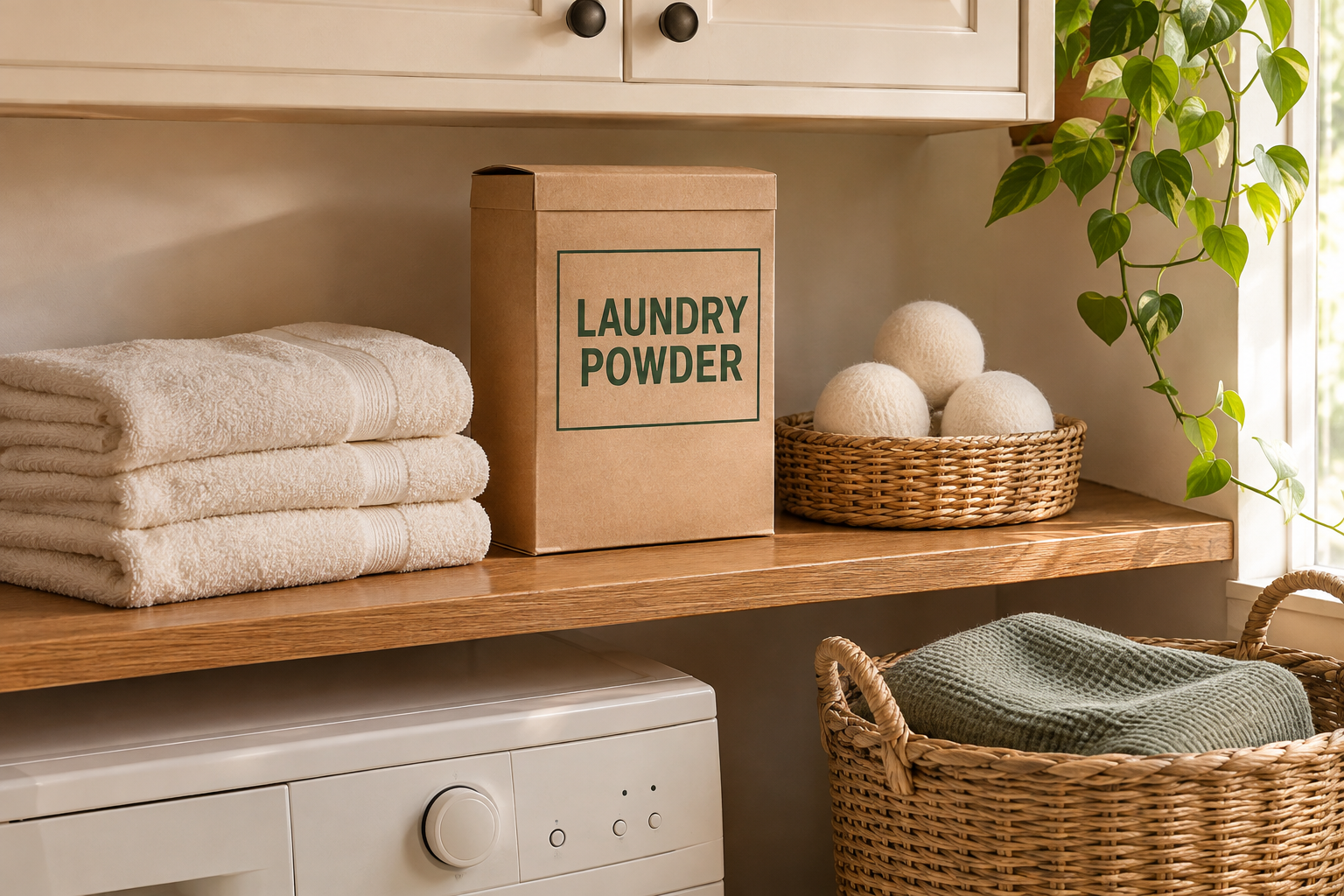
The featured image is an illustrative laundry setup, not a photograph of a specific recommended product.
Leave a Reply