
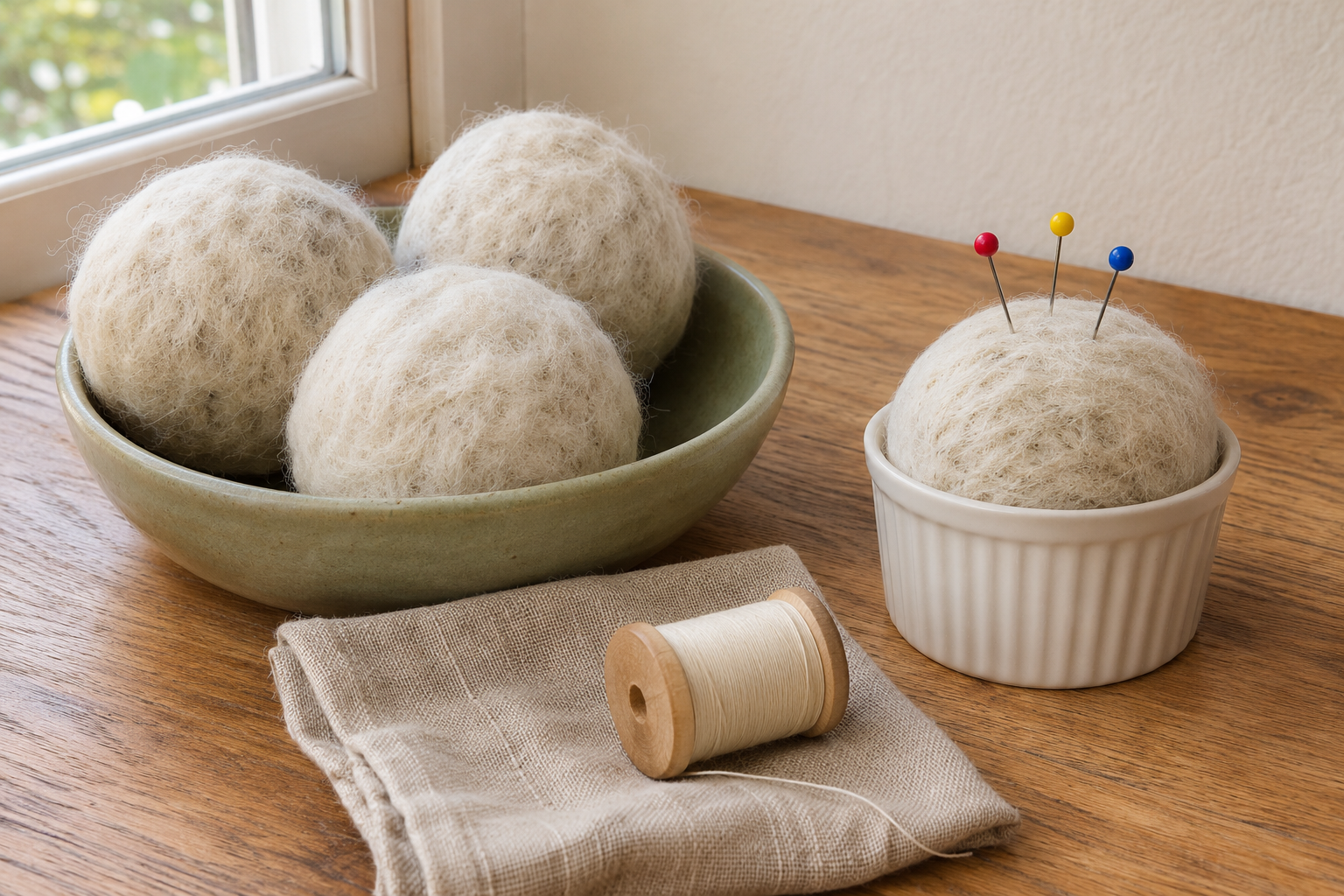
Before retiring a set of wool dryer balls, consider whether they are still usable or simply showing their age. If they have reached the end of their laundry life, a small household project may give them another purpose.
Repurposing works best when it fills an actual need. Choose a project you will use, or look for an appropriate composting or return route.
Reviewed and updated November 7, 2026.
Check Their Condition First
Look at the maker’s care and replacement guidance. A change in appearance does not, by itself, tell you everything about performance. If a ball is splitting, shedding pieces, or has a persistent odor, assess it before putting it back into a load or another household use.
- Check the material. Confirm whether the ball is entirely wool or includes a different core, decoration, or other components.
- Use clean, dry material. Follow the maker’s cleaning instructions and dry thoroughly before a craft or sewing project.
- Match the condition to the project. An intact ball may work as a pincushion; one that is falling apart may be better suited to an accepted end-of-life option.
- Keep repurposed items separate. Once a ball contains pins, glue, paint, or other craft materials, keep it out of the laundry set.
1. Make a Small Pincushion
An intact, dense ball can become a sewing pincushion, an idea also suggested by Smart Sheep. Seat it securely in a small cup or holder so it does not roll around while you work.
Check that the wool holds your pins securely, and store the finished pincushion with your sewing supplies, away from children and pets. Keep track of the pins and check the holder for stability each time you use it.
2. Use It as a Base for a Felt Decoration
If you already enjoy felt crafts, use a clean ball as the core of a simple ornament or decorative shape. Start with a project that suits your tools and experience, and use leftover materials where possible.
Keep the finished piece as a decoration rather than assuming it is suitable as a child’s or pet’s toy. If a project needs an entire new collection of supplies, consider whether it is a project you actually want to make.
3. Enclose Them in a Fabric Draft Stopper
A sewn fabric tube filled with old dryer balls is another reuse idea described by Smart Sheep. Use a sturdy fabric offcut, fit the tube to the gap you want to cover, and close it securely.
Check that the finished piece stays in place without obstructing the door or becoming a trip hazard. Treat it as a small practical project, not a substitute for fixing a window or door that needs proper maintenance.
4. Consider Composting Suitable Wool
Garden Organic includes natural fibers such as wool among compostable materials. That does not establish that every finished dryer ball belongs in every compost system.
Confirm the composition and any treatments with the manufacturer. Remove non-compostable attachments and ask your compost service whether it accepts wool textiles; acceptance of food scraps does not mean it accepts dryer balls. Follow the guidance for your system rather than assuming a dense ball will disappear quickly.
Do not treat an old ball as a ready-made fertilizer or mix unknown material into a houseplant pot simply to dispose of it.
5. Check for a Take-Back Option
Some makers offer a defined return route. For example, Friendsheep publishes a take-back program for retired wool dryer balls. Read the current acceptance and mailing instructions before sending anything.
Check your own brand first, and confirm eligibility, condition requirements, and postage. Do not assume that a textile collection bin or curbside recycling service accepts dryer balls.
Uses to Skip
A wool ball should not be relied on to dehumidify a closet or prevent mold. EPA’s moisture guidance focuses on fixing moisture sources and managing humidity and ventilation. A damp space needs attention to the cause.
Be cautious about turning worn balls into pet chew toys. Cornell’s Feline Health Center notes that swallowed fabric can cause intestinal obstruction. Natural wool is not automatically suitable for a pet that pulls off or swallows fibers. Choose a purpose-made toy appropriate for the animal.
There is also no need to add essential oils to make a reuse project worthwhile. An unscented pincushion or enclosed craft project can serve its purpose on its own.
Choose the Option You Will Actually Use
One useful pincushion is enough. If you do not need another craft item, check an accepted composting or return route instead of creating clutter in the name of reuse.
For more household ideas, explore Healthy Home & Environment. For laundry buying guidance, see Choosing Laundry Products, with individual product selections in River Cabinet.
Leave a Reply