
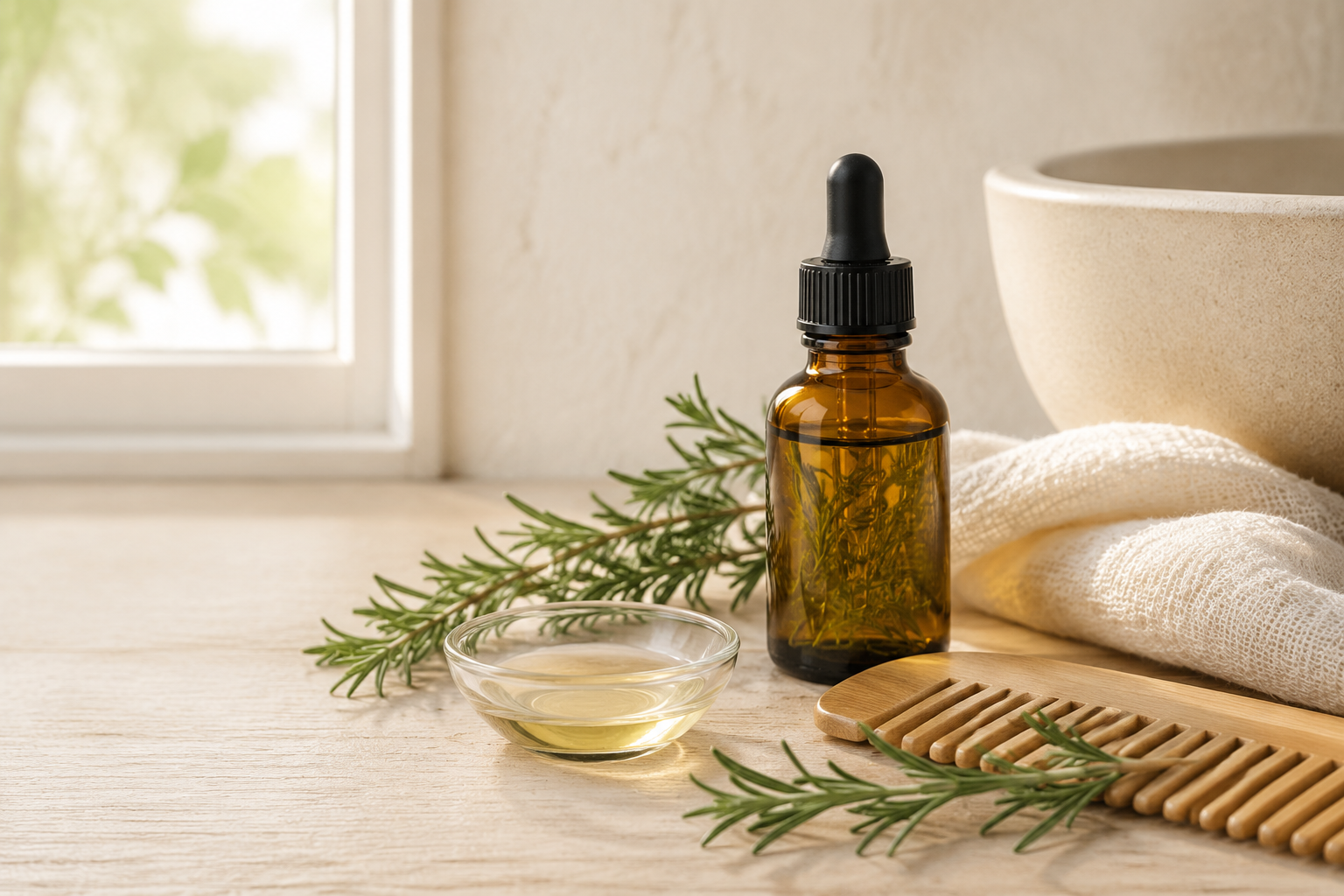
Rosemary has been valued for centuries as a culinary herb and aromatic plant. Its essential oil has recently become especially popular in hair-care routines, with claims ranging from thicker hair and a healthier scalp to improved memory and immunity.
Some of these ideas are supported by preliminary research, while others extend well beyond what human studies have demonstrated. Rosemary oil may be a useful addition to a thoughtful hair-care routine, but it is highly concentrated, can irritate the skin, and should not be treated as a cure for every kind of hair loss.
Here is what we currently know—and how to use it more safely.
Reviewed and updated November 7, 2026.
Can Rosemary Oil Promote Hair Growth?
The most frequently cited human study is a 2015 randomized trial involving 100 people with androgenetic alopecia, commonly called male- or female-pattern hair loss. Participants used either a rosemary-oil preparation or 2% minoxidil for six months.
Neither group experienced a significant increase in hair count after three months. After six months, however, both groups showed a statistically significant increase. Scalp itching was reported more frequently in the minoxidil group.
These findings are encouraging, but they require perspective. The study was relatively small, evaluated one type of hair loss, and did not include a placebo group. It does not establish that rosemary oil works for everyone or that any homemade rosemary blend is equivalent to minoxidil.
A 2024 scientific review concluded that rosemary oil is promising but that more rigorous clinical research is needed before its effectiveness can be firmly established.
What Rosemary Oil May—and May Not—Do
Early laboratory and clinical research suggests rosemary oil may influence inflammatory activity, oxidative stress, microorganisms, or pathways involved in the hair-growth cycle. The precise mechanism in humans remains uncertain, however.
Current evidence does not establish that rosemary oil:
- Works for every type of hair loss
- Produces rapid hair growth
- Permanently restores lost hair
- Prevents or reverses gray hair
- Replaces medical evaluation or proven treatment
- Corrects hair loss caused by nutritional deficiencies, thyroid disease, medication, illness, or hormonal changes
Any benefit is likely to be gradual. Hair naturally grows slowly, so a meaningful trial requires months rather than days or weeks.
Hair Loss Is Not One Condition
Before treating shedding at home, it helps to understand that hair loss has many possible causes.
These include:
- Androgenetic or pattern hair loss
- Temporary shedding after stress, illness, surgery, or childbirth
- Iron, protein, or other nutritional deficiencies
- Thyroid and hormonal disorders
- Autoimmune alopecia
- Scalp infections
- Medication side effects
- Traction from tight hairstyles
- Inflammatory or scarring scalp conditions
Rosemary oil has not been shown to treat all these conditions. Sudden shedding, round bald patches, scalp pain, sores, heavy scaling, or progressive thinning should be evaluated by a dermatologist or healthcare professional. Early evaluation is especially important when scarring hair loss is possible because permanent follicle damage can occur.
A Safer Rosemary Scalp-Oil Routine
Choose a professionally formulated scalp product with clear directions rather than treating a homemade blend as equivalent to the preparation studied in a clinical trial. The concentration, carrier, contact time, and frequency affect exposure; a homemade drop-count recipe is not a validated treatment regimen.
Do not apply undiluted essential oil. If a dermatologist recommends a custom dilution, use the concentration and measurement method they provide. Drops vary in volume, so six drops in 30 mL of carrier oil cannot reliably be labeled a 1% mixture.
Follow the finished product’s directions for amount, contact time, and rinsing. Longer exposure or overnight use has not been established as more effective. Avoid broken or inflamed skin and stop if irritation develops.
Test the Product Before Wider Use
For a new topical product, follow AAD’s small-area testing guidance over seven to 10 days, using the intended contact time. Home testing cannot rule out every allergy or replace clinical patch testing. Stop and wash off the product if redness, swelling, itching, blistering, or burning develops.
Can Rosemary Oil Help With Dandruff?
Rosemary essential oil has demonstrated antimicrobial and anti-inflammatory activity in laboratory research. That does not prove that it treats dandruff in people.
Flaking may result from seborrheic dermatitis, psoriasis, eczema, contact dermatitis, product buildup, or a fungal infection. These conditions may look similar but require different approaches.
A diluted rosemary product might feel soothing for some people, but it should not replace a diagnosis or an evidence-based dandruff treatment. Seek professional advice if scaling is persistent, painful, very itchy, spreading, or accompanied by hair loss.
Does Rosemary Oil Strengthen Hair?
An oil can temporarily coat the hair shaft, reduce friction, and improve softness or shine. This may make hair feel smoother and help limit mechanical breakage, particularly when the carrier oil is suited to the person’s hair type.
That is different from changing how strongly a strand is constructed inside the follicle. Claims that rosemary oil permanently strengthens each strand or repairs split ends should therefore be viewed cautiously. Split ends cannot be fused permanently and eventually need to be trimmed.
Gentle handling, limiting excessive heat and chemical processing, avoiding tight hairstyles, and eating adequate protein and micronutrients remain important parts of maintaining healthy hair.
Rosemary Aroma, Memory, and Focus
Small studies have explored whether rosemary aroma or rosemary preparations influence alertness, mood, or certain measures of memory. Some have reported short-term changes, but results vary according to the preparation, dose, study population, and cognitive task.
This research is interesting, but it does not establish rosemary essential oil as a treatment for memory loss, brain fog, dementia, anxiety, depression, or fatigue.
If you enjoy the scent, inhaling it gently from the open bottle or an aroma strip may be part of a pleasant personal ritual. Stop if it causes headache, nausea, coughing, dizziness, or breathing irritation. Diffusion is not necessary to receive hair-care benefits.
Claims That Need More Evidence
Rosemary essential oil is often advertised for many conditions. At present, topical or aromatic use has not been established as a way to:
- “Boost” the immune system
- Prevent infection throughout the body
- Treat acne reliably
- Relieve chronic joint or muscle pain
- Prevent premature graying
- Improve cognitive decline
- Balance hormones
- Detoxify the body
Laboratory findings about antioxidant, antimicrobial, or anti-inflammatory activity cannot automatically be translated into clinical benefits for people. Concentrations that affect cells or microorganisms in a laboratory may not be safe, achievable, or effective on human skin.
Important Safety Precautions
Use rosemary essential oil thoughtfully:
- Never apply it undiluted to the scalp or skin.
- Do not swallow essential oil unless a qualified clinician has prescribed a regulated product for a specific purpose.
- Keep it away from the eyes, inside of the nose, mouth, and other sensitive tissue.
- Wash your hands after applying it.
- Do not use it on broken or inflamed skin.
- Stop immediately if it causes burning, rash, swelling, wheezing, or other concerning symptoms.
- Store it securely away from children and pets.
- Do not add it directly to a bath, because oil does not disperse evenly in water.
- Ask a healthcare professional before use if you are pregnant, breastfeeding, managing epilepsy or another seizure disorder, treating a child, or living with a significant medical or skin condition.
If essential oil is swallowed, do not induce vomiting. In the United States, contact Poison Control at 1-800-222-1222 or use webPOISONCONTROL.
A Note for Homes With Cats and Dogs
Concentrated essential oils can present risks to pets through ingestion, skin contact, spills, or inappropriate diffusion. Cats are particularly vulnerable to several essential-oil compounds because of differences in metabolism.
Do not apply your hair blend to a pet. Store bottles securely, wash oil from your hands before handling an animal, and prevent pets from licking treated hair, skin, spills, or oil-covered bedding. Ask your veterinarian before diffusing essential oils in a home shared with animals—especially senior pets or those with respiratory or liver conditions.
How to Choose Rosemary Oil
If you decide to use rosemary essential oil, look for a product that provides:
- The botanical name, usually Salvia rosmarinus or its older synonym Rosmarinus officinalis
- Rosemary as the only listed essential-oil ingredient
- The extraction method
- A batch or lot number
- Storage and safety directions
- A dark glass bottle with a secure cap
- Independent purity testing or a certificate of analysis when available
The label “therapeutic grade” is primarily a marketing term rather than a universally regulated quality standard. Organic certification can describe agricultural practices, but it does not establish that an essential oil is effective or non-irritating.
Store the bottle tightly closed and away from heat and direct sunlight. Oxidized essential oils may be more likely to irritate the skin.
Final Thoughts
Rosemary oil may be a reasonable complementary option for adults experiencing pattern hair thinning, provided it is diluted carefully and used consistently. The human evidence is promising but still limited, and visible change—if it occurs—may take six months or longer.
It is not a universal treatment for shedding, dandruff, gray hair, or underlying medical conditions. Supporting healthy hair also means identifying the cause of hair loss, eating adequately, treating scalp disease, protecting fragile strands, and seeking professional guidance when changes are sudden or persistent.
At River Ternary, embracing natural ingredients does not mean exaggerating their abilities. It means respecting their potency, understanding the available evidence, and using them in ways that support rather than compromise our well-being.
Have you tried diluted rosemary oil as part of your hair-care routine? Share what you noticed—and how long you used it—in the comments below.
Sources & Further Reading
- Panahi Y, et al. Rosemary oil vs. minoxidil 2% for the treatment of androgenetic alopecia: A randomized comparative trial. Skinmed. 2015.
- Bin Rubaian NF, Alzamami HFA, Amir BA. An overview of commonly used natural alternatives for the treatment of androgenetic alopecia, with special emphasis on rosemary oil. Clinical, Cosmetic and Investigational Dermatology. 2024.
- Pengelly A, et al. Short-term study on the effects of rosemary on cognitive function in an elderly population. Journal of Medicinal Food. 2012.
- National Capital Poison Center: Essential Oils—Poisonous When Misused
- American Academy of Dermatology: Testing Skin Care Products.
This article is for educational purposes and is not a substitute for individualized medical or dermatological advice.
Leave a Reply